DEFINING ATTR

Transthyretin-mediated amyloidosis (ATTR) is an underdiagnosed, progressive, debilitating, and fatal disease1

MULTISYSTEM MANIFESTATIONS1-3

TTR amyloid deposits accumulate in various parts of the body, including:

Heart

Nerves

Musculoskeletal
system

Gastrointestinal
tract

Other

Delayed diagnosis

Patients with ATTR may be diagnosed 3 to 8 years after symptom onset.1,4,5

Limited survival time

The median survival for patients with untreated ATTR is 2.5 to 5.5 years post-diagnosis.6-9

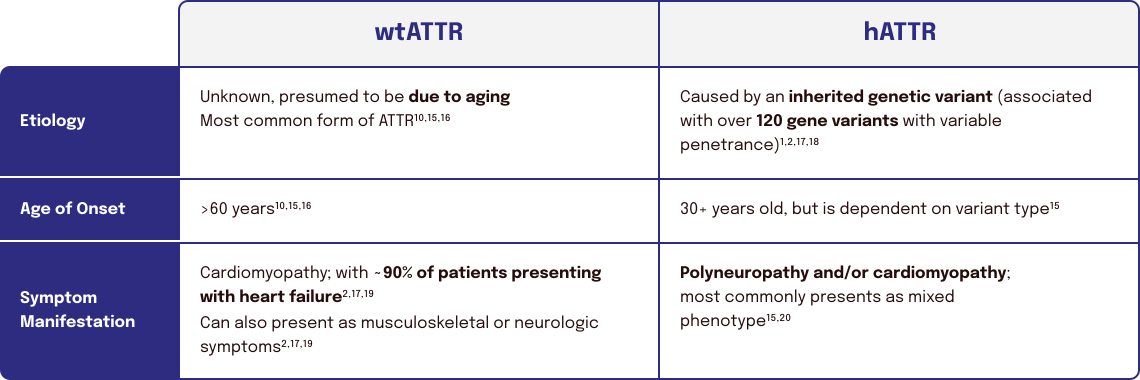
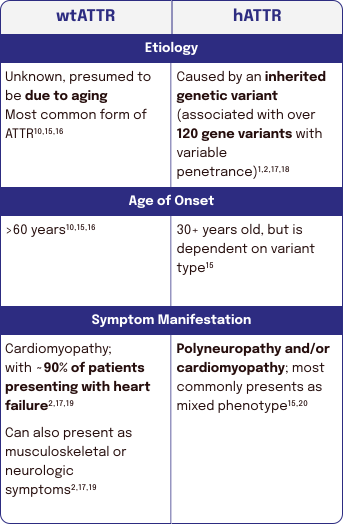
There are two types of ATTR: wild-type and hereditary10

Both wild-type and hereditary ATTR lead to the accumulation of TTR amyloid deposits in multiple organs of the body.11-14

V122I (V142I) patients are at higher risk of rapid hATTR progression21

The V122I variant primarily affects African American families and is associated with increased morbidity and mortality vs other variants and wtATTR.2,19,22

Prevalence2,19,22

  • ~4% of African Americans carry the V122I variant, making it the most common hATTR variant in the United States

Median Survival3,5,23

  • 2.6 years is the median survival time for V122I patients, compared to 5.8 years for patients with other variants, following an hATTR diagnosis

Disease severity21,22

  • V122I variant is associated with more aggressive disease progression compared to other variants or wtATTR, including higher risk of heart failure and death

Mixed phenotype24

  • Patients with the V122I variant often present with a mixed phenotype, in which cardiomyopathy may coincide with or follow polyneuropathy

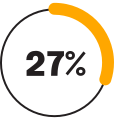
Percentage of V122I (V142I) patients with multisystem manifestations2,3,25

Cardiac
complications

Sensory
neuropathy
Gastrointestinal
symptoms

Renal
impairment
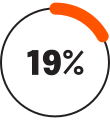
Motor
neuropathy

ATTR=transthyretin-mediated amyloidosis; TTR=transthyretin; hATTR=hereditary transthyretin-mediated amyloidosis; wtATTR=wild-type transthyretin-mediated amyloidosis.

References:

  1. Hawkins P et al. Ann Med. 2015;47(8):625-638.
  2. Maurer MS et al. J Am Coll Cardiol. 2016;68(2):161-172.
  3. Kittleson MM et al. J Am Coll Cardiol. 2023;81(11):1076-1126.
  4. Adams D et al. J Neurol. 2021;268(6):2109-2122.
  5. Rozenbaum MH et al. Cardiol Ther. 2021;10(1):141-159.
  6. aus dem Siepen F et al. Clin Res Cardiol. 2019;108(12):1324-1330.
  7. Gertz MA et al. Mayo Clin Proc. 1992;67(5):428-440.
  8. Swiecicki PL et al. Amyloid. 2015;22(2):123-131.
  9. Givens RC et al. Aging Health. 2013;9(2):229-235.
  10. Nativi-Nicolau JN et al. Heart Fail Rev. 2022;27(3):785-793.
  11. Koike H & Katsuno M. Biomedicines. 2019;7(1):11.
  12. Adams D et al. Neurology. 2015;85(8):675-682.
  13. Adams D et al. Curr Opin Neurol. 2016;29(suppl 1):S14-S26.
  14. Mohty D et al. Arch Cardiovasc Dis. 2013;106(10):528-540.
  15. Ruberg FL et al. J Am Coll Cardiol. 2019;73(22):2872-2891.
  16. Ando Y et al. Orphanet J Rare Dis. 2013;8:31.
  17. Kourelis TV & Gertz MA. Expert Rev Cardiovasc Ther. 2015;13(8):945-961.
  18. Sekijima Y. J Neurol Neurosurg Psychiatry. 2015;86(9):1036-1043.
  19. Maurer MS et al. Circ Heart Fail. 2019;12(9):e006075.
  20. Coelho T et al. Curr Med Res Opin. 2013;29(1):63-76.
  21. Kittleson MM et al. Circulation. 2020;142(1):e7-e22.
  22. Kozlitina J et al. J Card Fail. 2022;28(3):403–414.
  23. Lane T et al. Circulation. 2019;140(1):16-26.
  24. Grogan M et al. HFSA Conference 2019. Philadelphia, USA.
  25. Wixner J et al. Orphanet J Rare Dis. 2014;9(61):1-9.