Physician Directory
Find a Physician Physician Registry Form
For US HCPs For Patients   Connect With Us
Cardiomyopathy of ATTR logo, click to return to homepage Cardiomyopathy of ATTR logo, click to return to homepage Cardiomyopathy of ATTR logo, click to return to homepage
For US HCPs
About ATTR   
  • Defining ATTR
  • Mechanism of Disease
Red-Flag Symptoms Suspecting ATTR Diagnosis Treatment Options Resources For Patients
Physician Directory
Find a Physician Physician Registry Form
Connect With Us

Site map

  • Home
  • About ATTR
    • — Defining ATTR
    • — Mechanism of Disease
  • Red-Flag Symptoms
  • Suspecting ATTR
  • Diagnosis
  • Treatment Options
  • Resources
  • Connect With Us
  • Find A Physician
  • Physician Registry Form
AMVUTTRA™ (vutrisiran) logo

You are now leaving amvuttra.com.

You are now being directed to another Alnylam website.

Proceed Cancel
AMVUTTRA™ (vutrisiran) logo

You are now leaving amvuttra.com.

Links to all outside
sites are provided as a
reference for our visitors.
Alnylam Pharmaceuticals does
not endorse and is not responsible
for the content on sites that
are not owned and operated by
Alnylam Pharmaceuticals.

Proceed Cancel
AMVUTTRA™ (vutrisiran) logo

This email address is already in use.

Please press Cancel to enter another email, or press Update to receive an email that will allow you to update your preferences.

AMVUTTRA™ (vutrisiran) logo

Email sent!

A link has been sent to your email address.

Modal title
...
You are now leaving ATTR‑Amyloidosis.com

You are now being directed to another Alnylam website.

OK
You are now leaving ATTR‑Amyloidosis.com

Links to all outside
sites are provided as a
reference for our visitors.
Alnylam Pharmaceuticals does
not endorse and is not responsible
for the content on sites that
are not owned and operated by
Alnylam Pharmaceuticals.

OK
THE SITE YOU ARE ABOUT
TO ENTER IS INTENDED FOR
US HEALTHCARE PROFESSIONALS

Are you a
US healthcare professional?

Confirm and Enter Visit patient site
Thank you

Your request has been submitted.

Submitting your request

Submitting your request.

This email address is already in use
Update
Email sent!

A link has been sent to your email address.

OK
Title will be here

Lorem Ipsum has been the industry's

Title will be here

Lorem Ipsum has been the industry's

Title will be here
Eyebrow text here
body text here

Lorem Ipsum has been the industry's

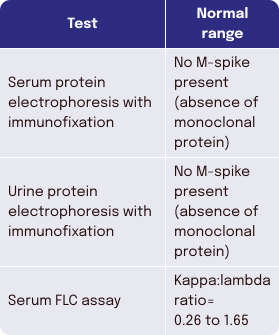
AL amyloidosis screening11

The diagnostic algorithm should always begin with a monoclonal protein screen to assess for AL amyloidosis. If AL amyloidosis is suspected, initiate laboratory testing to assess for monoclonal protein production and evidence of vital organ involvement or dysfunction. In AL amyloidosis, free lambda or free kappa levels are elevated.

A chart showing a diagnostic algorithm for ATTR-CM amyloidosis A chart showing a diagnostic algorithm for ATTR-CM amyloidosis
ASNC Guidance for 99mTc-PYP Grading14
Two approaches for quantifying cardiac uptake of 99mTc-PYP using planar & SPECT imaging:
  1. Quantitative heart to contralateral lung (H/CL) ratio of uptake at one hour: ATTR-positive if ≥1.5 in the presence of myocardial PYP uptake confirmed on SPECT
  2. Semi-quantitative, visual scoring method to compare myocardial uptake to bone uptake at three hours: ATTR‑positive if ≥Grade 2
A chart showing a diagnostic algorithm for ATTR-CM amyloidosis A chart showing a diagnostic algorithm for ATTR-CM amyloidosis
Guidance recommends using SPECT or SPECT/CT in addition to planar imaging to confirm diagnosis and avoid false positives.
Review ASNC Guidance
Biopsy of affected tissues can detect TTR amyloid deposition2,5,10-12
Tissue biopsy can help confirm a diagnosis of ATTR when noninvasive screenings are unavailable or inconclusive.
Standard technique
Biopsy of affected tissue with Congo red staining can detect TTR amyloid deposition.
Use in cardiology
Cardiac tissue biopsy is used when nuclear scintigraphy is negative/equivocal despite a high clinical suspicion of ATTR-CM, or if scintigraphy is unavailable.
Use in neurology
Tissue biopsy is used in the absence of a family history of ATTR, or when genetic testing is inconclusive despite family history, and a high clinical suspicion of hATTR-PN remains.
Alnylam Pharmaceuticals logo, click to visit corporate website

References

  • TK1

    TK2

  • TK3

    TK4

Footer
  • Privacy Policy
  • Legal Notice
  • Contact US
  • Site map

Loreum

© 2026 Alnylam Pharmaceuticals, Inc. All rights reserved.
The information on this site is intended for US healthcare professionals. TTR-USA-00519